
guide
Singlet vs Fight Shorts and Compression Shirt: Which Should Your Team Wear?
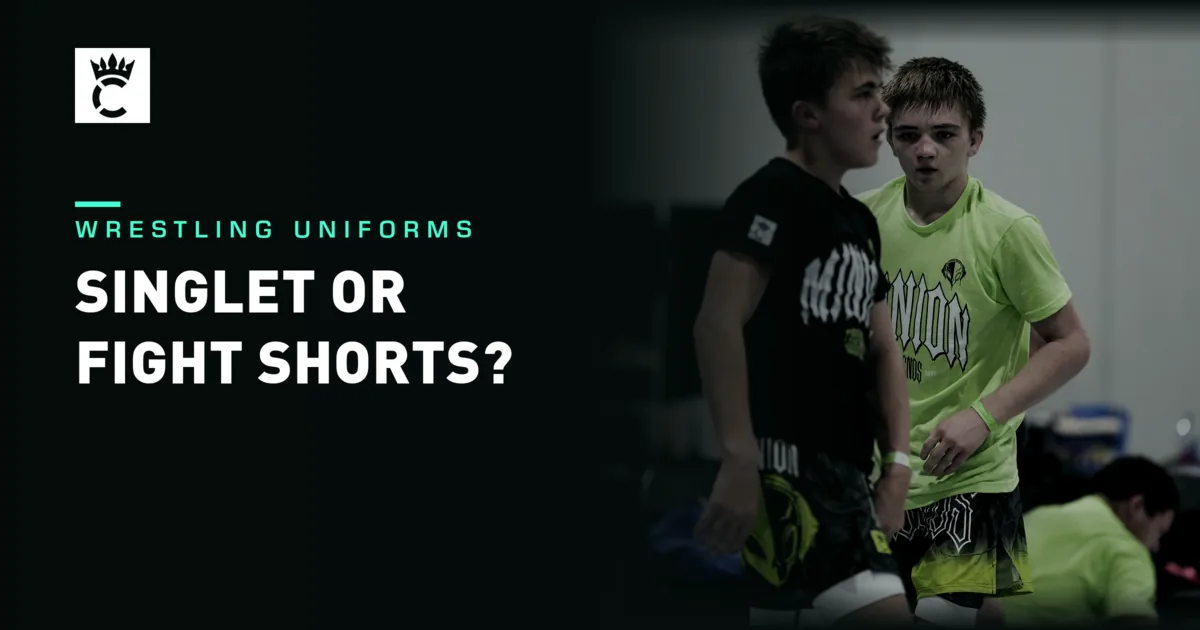
Quick answer: Neither wins outright, and at the high school level you don't have to pick just one. NFHS has allowed a two-piece uniform (compression top with fight shorts or compression shorts) alongside the singlet since 2017-18. The two-piece is more comfortable for kids who won't come out in a singlet and is easier to size. The singlet has nothing loose to catch, costs one garment instead of two, and is still what wrestlers need for USA Wrestling freestyle and Greco championships. If you have club kids, keep a singlet in every kit and offer the two-piece on top of it.
Every wrestling room has this argument. Ask wrestlers which they prefer and you get a split: some swear a singlet looks more intimidating, others would take a compression shirt and shorts every time.
Most of that debate is about preference. A coach has to answer a different question: what do I put on this roster, what will it cost, and will it be legal at every event we go to? Here's how we'd work through it. We make both, so we don't need you to land on either side.
What the rules allow
NFHS approved the alternate two-piece uniform for 2017-18, giving wrestlers the option of it or the traditional singlet. The 2023-24 rule language and this state association summary lay out the details. In short:
- Shorts: compression shorts or shorts designed for wrestling, with a minimum 4-inch inseam that doesn't extend below the knee. Shorts designed for wrestling need an elastic waistband. No exposed drawstrings, belt loops, zippers, snaps, buttons or pockets.
- Shirt: form-fitted compression shirt that doesn't cover or extend below the elbow, with a minimum 3-inch tail. It can go with the shorts or under a singlet.
- Undergarments: a suitable undergarment covering the buttocks and groin goes under both the singlet and the shorts. Girls also need breast coverage under either uniform; see our guide on what goes under a singlet.
- School-issued: the singlet, shorts and shirt all have to be school-issued. A kid can't just show up in whatever they bought online.
Rule language changes and states add their own interpretations, so read the current NFHS rulebook and check with your state association before you order.
The catch comes in the off-season. USA Wrestling's rule book says a two-piece uniform designed for wrestling is legal in USAW folkstyle only, and two-piece uniforms aren't allowed at USAW freestyle or Greco-Roman regional or national championships. A kid who only owns a two-piece can wrestle your folkstyle season and still have nothing legal to wear at those events. For college, check the NCAA rulebook.
The trade-offs, side by side
| Singlet | Compression top + fight shorts | Compression top + compression shorts | |
|---|---|---|---|
| Coverage and comfort | Least coverage; the reason some kids balk | Most coverage; feels like normal athletic clothes | Covered, but still skin-tight |
| Loose fabric | None | Some, depending on the cut | None |
| Stays in place | One piece, nothing to untuck | Shirt can ride up; waistband has to hold | Shirt can ride up |
| Sizing | One size has to fit torso and hips | Top and bottom sized separately | Top and bottom sized separately |
| Garments to buy | One | Two | Two |
| USAW freestyle/Greco championships | Yes (check the color and cut rules) | No | No |
Does the two-piece bring in more kids?
This is the argument that matters most to a program, and the honest answer is that nobody has settled it. NFHS said it approved the two-piece in the hope of increasing boys' and girls' participation, after favorable results from experimentation and positive comments from schools, coaches and officials.
What you'll find from there is mostly coaches' experience. One coach on Reddit personally prefers singlets but reports numbers jumping on their high school and middle school teams after the change. The pushback, from another thread, is that a kid who rejects the sport over a singlet will reject it over compression gear too. Coaches are still asking for real retention data, and we aren't aware of solid published numbers either.
So we won't promise you a bigger roster. But if a singlet is the reason one freshman stays out of the room, that's a kid you'd lose over a uniform, and offering the option is an easy fix. If you've heard that objection from parents, our piece on why wrestling uniforms are cut the way they are is a useful one to send them.
Grab risk: what actually matters
The real knock on fight shorts is loose fabric. Baggy shorts give fingers and toes something to catch in a scramble, and a shirt can come untucked. A cut built for wrestling takes care of much of that, while a pair of gym shorts won't.
Look for three things: a short built for grappling rather than a general athletic short, a waist that doesn't shift, and enough shirt tail to stay tucked. Our Pro Series Fight Short uses a hybrid cut that reduces grab fabric, with a silicone-lined waistband, a hook-and-loop closure with an internal drawstring, and no pockets or zippers. It comes in a 5-inch or 7-inch inseam in adult sizes and 5 to 7 inches in youth sizes. The women's cut has a 4.5-inch inseam. All of those clear the 4-inch minimum, but if your state reads closures strictly, run the spec past your rules interpreter first.
Compression shorts remove the question altogether. One coach's roster sorted itself by build: lightweights leaned toward singlets, and went with compression shorts when they did wear two pieces, while lanky kids liked the two-piece most. The trade is that a kid who didn't want the singlet's fit may not want skin-tight shorts either. That's why fight shorts are often the one that gets a hesitant kid in the door.
Cost and logistics
A two-piece means two garments per kid instead of one, so expect it to cost more than a singlet alone. It also means two sizes to record per wrestler and two pieces to collect at the end of the season.
There's an upside on sizing, though. A long-torsoed kid with narrow hips is hard to fit in a one-piece, and with a two-piece you simply size the top and bottom separately. Before you order, pull the numbers from the men's and boys' or women's and girls' size guide. If you're also working out singlet quantities, we've covered how many to order in each size.
How to offer both without splitting the team's look
A mixed lineup only looks messy when the pieces come from different places. Because the art is sublimated, the same design can go on the singlet, the compression top and the shorts, so a wrestler in a two-piece and a wrestler in a singlet still read as one team.
Here's the order we'd do it in:
- Confirm with your state association that both options are allowed, and ask about any local rules on mixing them in the same lineup.
- Find out who wrestles off-season. Anyone heading to freestyle or Greco championships needs a singlet regardless of what they wear in the winter.
- Ask the roster. Let wrestlers and parents tell you what they want before you commit to quantities, because kids who'd quietly skip the sport won't always say so in front of the team.
- Get one design across all three pieces. Ask for free design mockups on the singlet, top and shorts together so you can see the match before you order.
- Order with time to spare. Check how long custom uniforms take against your first dual or tournament.
If you'd rather not choose, the Dual Threat bundle on our wrestling bundles page is built for this: Pro Series Singlet, Compression Top and Pro Series Fight Shorts, listed at $130. Every wrestler has both options and a legal uniform for the off-season.
Our recommendation
Mostly club kids who wrestle year-round: make the singlet your base and add the two-piece for anyone who wants it.
A school or middle school program trying to grow: offer the two-piece from day one and keep singlets available. Don't let the uniform be the reason a kid says no.
A tight budget and a settled roster: singlets alone are one garment per kid and legal everywhere we've covered here. Add shorts and tops when you can.
Whichever way you go, send us your roster and colors and we'll put together free design mockups for all of it.
Frequently asked questions
Are fight shorts legal for high school wrestling?
Yes, under NFHS rules, when they're shorts designed for wrestling: minimum 4-inch inseam, not below the knee, elastic waistband, and no exposed drawstrings, belt loops, zippers, snaps, buttons or pockets. They must be school-issued, and they may be worn with a form-fitted compression shirt or over a singlet. Check the current rulebook and your state association.
Can high school wrestlers choose between a singlet and a two-piece?
NFHS approved the two-piece in 2017 as an option alongside the singlet. How that works on your team depends on what your school issues, and your state association can confirm any local rules about mixing both in one lineup.
Is a two-piece uniform allowed at USA Wrestling events?
USA Wrestling's rule book allows a two-piece uniform designed for wrestling in USAW folkstyle only. It isn't allowed at USAW freestyle or Greco-Roman regional or national championships, so wrestlers competing there need a singlet. Check the current rule book and the event's own rules.
Can you wear fight shorts over a singlet?
Yes. NFHS rules say shorts designed for wrestling may be worn over the singlet, and they must be school-issued. It's a simple option for a wrestler who wants more coverage without a separate top.
Do two-piece wrestling uniforms cost more than singlets?
Usually, since you're buying two garments instead of one. Our Dual Threat bundle combines a Pro Series Singlet, Compression Top and Pro Series Fight Shorts at a listed $130, and a custom quote will price your exact team order.